Don't Miss This Exclusive Offer!
Register for our IELTS preparation course today and get a massive discount on your first mock test.
Claim Offer NowEnroll in a class, book a test, or find your perfect course instantly.
Explore sample questions and master key strategies for all four test modules.
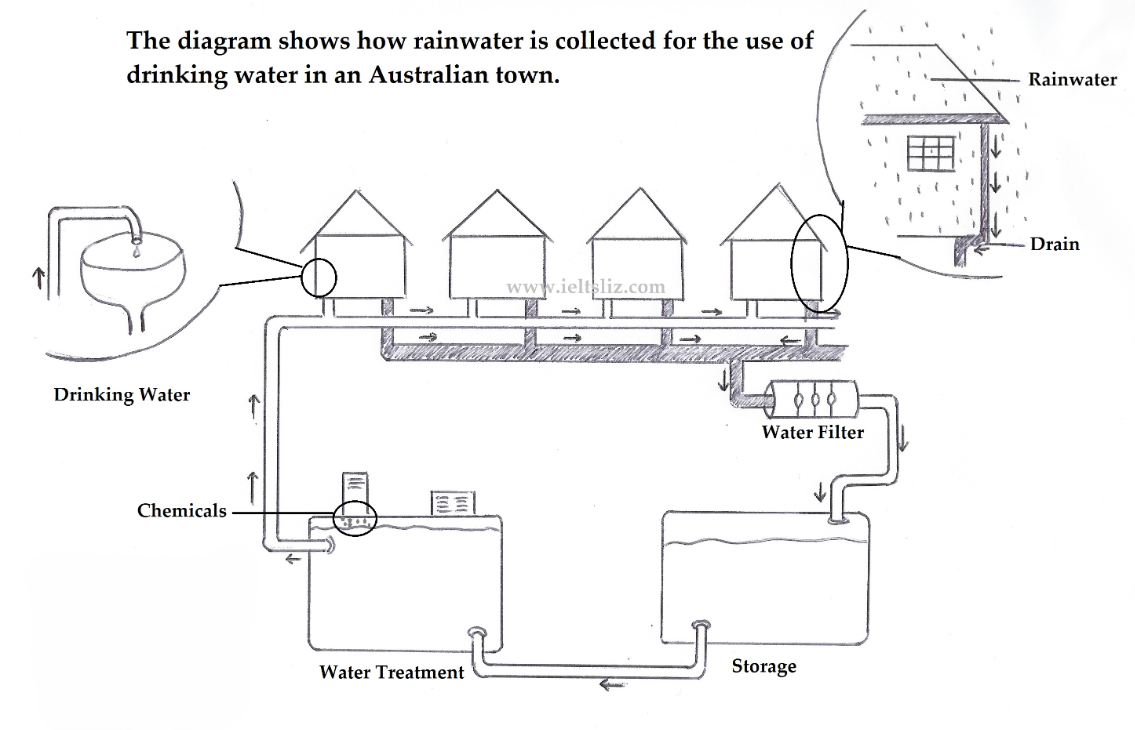
Prompt: The diagram illustrates how an Australian town processes rainwater to use as drinking water. Summarise the information by selecting and reporting the main features.
Prompt: Some people believe that unpaid community service should be a compulsory part of high school programmes. To what extent do you agree or disagree?
Allocate 20 minutes for Task 1 and 40 for Task 2. Task 2 carries more weight in your final score.
For Task 2, use a clear structure: Introduction, 2-3 body paragraphs with supporting examples, and a conclusion.
In your introduction for both tasks, rewrite the question in your own words. Do not copy it directly.
In Task 1, identify and report the main trends and key features. Avoid describing every single data point.
The concept of 'biophilia' suggests that humans possess an innate tendency to seek connections with nature. Harvard biologist E. O. Wilson popularized this idea, arguing that our attraction to nature is genetically predetermined. Studies have shown that patients in hospitals who have a view of trees recover faster than those who only see a brick wall.
Do the following statements agree with the information? Write TRUE, FALSE, or NOT GIVEN.
Before reading the questions, skim the entire passage (2-3 minutes) to understand the main topic and overall structure.
Once you read a question, identify keywords (names, dates, nouns) and scan the passage to locate the relevant section quickly.
You have 60 minutes for 40 questions. If a question is too difficult, make an educated guess and move on. You can come back if you have time.
Pay close attention to instructions like "NO MORE THAN TWO WORDS". Exceeding the word limit will result in a wrong answer.
The title and any subheadings provide a quick summary of what the text is about, helping you to predict the content.
Underlining key information while you read can help you locate answers more easily when you are answering the questions.
Librarian: Can I take your name? Student: Yes, it's Maria Thompson. Librarian: Is that T-H-O-M-P-S-O-N? Student: That's right. And my date of birth is July 15th, 1998...
Complete the form below. Write NO MORE THAN ONE WORD AND/OR A NUMBER.
Use the time given before each section to read the questions and predict the type of information you need to listen for (e.g., a name, a number, a date).
Pay attention to 'signposting words' like "however," "firstly," "in conclusion," which guide you through the conversation or lecture.
Practice reading the question, listening for the answer, and writing it down simultaneously. Don't fall behind the audio.
The audio doesn't stop. If you miss an answer, leave it blank and focus on the next question. You can guess the missed answer later.
The speakers will often use synonyms for the keywords you see in the questions. Listen for the meaning, not just the exact words.
You get 10 minutes at the end to transfer your answers. Use this time to check for spelling and grammar mistakes carefully.
Describe a memorable trip you have taken.
You should say:
- where you went
- who you went with
- what you did on the trip
and explain why this trip was so memorable for you.
Avoid long pauses. Use linking words (e.g., "furthermore," "on the other hand") to connect your ideas smoothly. It's okay to use fillers to give you a moment to think.
Avoid simple "yes" or "no" answers. Always provide reasons, details, and examples to demonstrate your language ability.
Showcase your lexical resource. Try to use synonyms and less common words where appropriate, but ensure you use them correctly.
Use a mix of simple, compound, and complex sentences. This demonstrates grammatical range and accuracy, which is a key marking criterion.
Speak clearly and at a natural pace. Pay attention to word stress and intonation. You don't need a native accent, but you must be easily understood.
The examiner is there to assess your English, not your knowledge. Smile, be confident, and treat it like a natural conversation.
Take our full-length IELTS Academic Mock Test for free. Please provide your contact details below to access the test instantly.
Your details are secure. Click submit to access the test immediately.